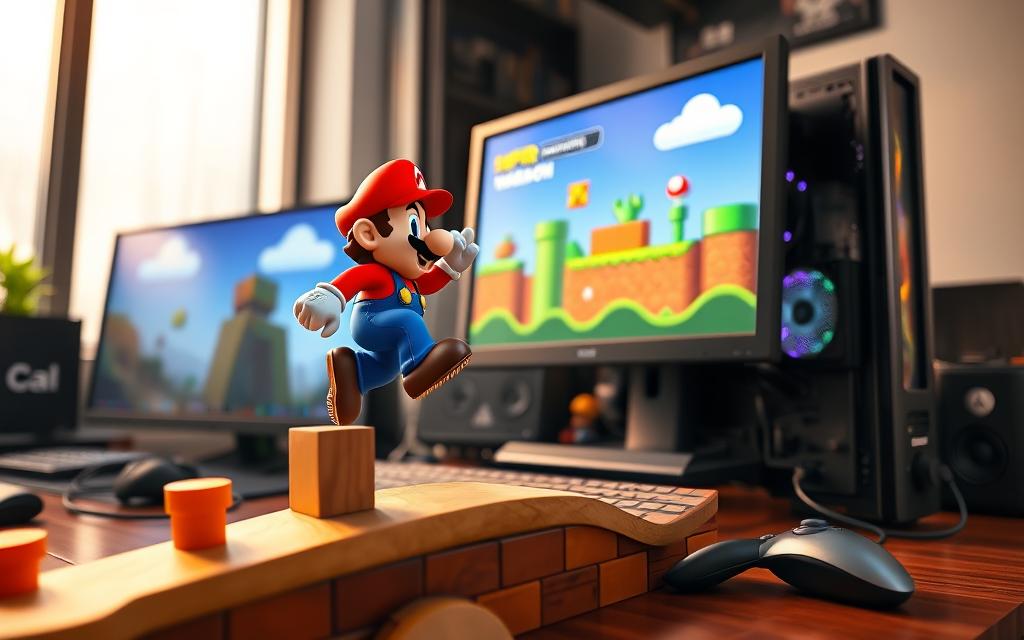
The phenomenon of Super Mario games being adapted for PC has garnered significant attention in the gaming community. Despite Nintendo’s traditional console exclusivity, fan-made ports have emerged, showcasing the technical prowess and passion of the fan base.
These projects have not only gained popularity but have also created a thriving ecosystem of developers. The ability to download and play these games on PC has opened up new avenues for gamers. The Internet Archive and Software Library have played a crucial role in preserving and making these games accessible.
The significance of these port projects lies in their ability to bridge the gap between Nintendo’s console exclusivity and the PC gaming community. This article will explore the most notable projects, their technical achievements, and what they mean for both Nintendo fans and the broader gaming community.
The world of gaming has witnessed a significant surge in Mario PC port projects, captivating both nostalgic gamers and developers alike. This phenomenon can be attributed to the community’s passion for preserving classic games and making them accessible on modern hardware.
Why Fans Are Creating PC Ports
Fans create PC ports of classic Mario games for several reasons, including preservation, accessibility, and the technical challenge it presents. The decompilation movement has evolved into full-fledged community projects, with many developers contributing to these efforts. As a result, classic titles are now available with enhancements such as higher resolutions and frame rates.
Legal Considerations and Nintendo’s Stance
Nintendo has historically been protective of their intellectual property, which affects the legality of these port projects. To navigate copyright concerns, fan developers often require users to provide their own ROM files, thus avoiding direct infringement. The community self-regulates to ensure these projects remain within the legal grey area, allowing fans to enjoy classic Mario games on PC.
To start your Mario PC port journey, you’ll need to familiarise yourself with the essential software and development environments. This involves understanding the tools required to compile and run the game on PC.
The foundation of most Mario port projects is MSYS2, a software distribution and building platform for Windows. You’ll also need to install Python and specific development environments tailored to your project.
MSYS2 and Development Environments
MSYS2 provides a Unix-like environment on Windows, necessary for compiling the game’s source code. Configuring MSYS2 correctly is crucial for a successful port.
Builder Applications
Tools like sm64pcBuilder2 simplify the compilation process. They offer options for downloading patches, models, and texture packs, making it easier to get started.
Finding Source Code and Resources
Legitimate source code repositories can be found on platforms like GitHub. Look for active projects like sm64ex, Render96ex, and others that provide the necessary files and documentation.
Setting Up Your Development Environment
Ensure you have the necessary libraries and dependencies installed. Properly separating Nintendo’s copyrighted assets from the open-source code is also crucial for legal compliance. For more information on setting up a development environment, you can refer to guides like the one on David Burela’s blog.
Notable Mario PC Port Projects
The world of Mario PC port projects is vast and diverse, with numerous endeavours that showcase the dedication of the gaming community. These projects not only demonstrate technical skill but also a deep affection for the Mario series.
Super Mario64 Decompilation Project
The Super Mario64 Decompilation Project is a groundbreaking endeavour that has made PC ports of the game possible by reverse-engineering its code. This project supports multiple rendering backends, including DirectX12 and OpenGL, ensuring compatibility with various operating systems, including Windows and Linux.
Original Super Mario Bros. Port by Lukazs Jakowski
Lukazs Jakowski’s port of the original Super Mario Bros. is a testament to the possibility of porting even the earliest Mario titles to modern systems with high fidelity. This project faithfully recreates the NES classic, showcasing the technical achievements of the developer.
Community Enhancement Projects
Community enhancement projects build upon base ports to add new features and improvements. These projects include texture packs and visual improvements, as well as multiplayer modifications.
Texture Packs and Visual Improvements
Texture packs like MollyMutt’s, Hypatia’s Mario Craft64, and SM64 Redrawn transform the visual experience of classic games, offering a fresh perspective on beloved titles. These enhancements demonstrate the community’s creativity and commitment to improving the gaming experience.
Multiplayer Modifications
Multiplayer modifications, such as Net64, enable friends to play together in games that were originally single-player experiences. This extends the longevity and appeal of decades-old games through modern enhancements.
Conclusion: The Future of Fan-Made Mario PC Ports
As fan-made Mario PC ports continue to evolve, their significance in gaming preservation and community development becomes increasingly apparent. The current state of these projects demonstrates a strong commitment to preserving classic titles and making them accessible to new audiences.
Despite Nintendo’s legal challenges, these fan projects continue to thrive, showcasing the delicate balance between fan creativity and respect for intellectual property rights. Fan-made Mario PC ports not only demonstrate technical achievement but also highlight the enduring appeal of Mario games across generations.
The future of these projects may include more advanced features and improved tools, relying on the continued support of the gaming community and the creativity of developers. Fans must explore these projects responsibly while respecting copyright considerations.
FAQ
What software is required to run a Super Mario game on a computer?
To run a Super Mario game on a computer, you’ll need to download and install the required software and files from a reliable source, such as the Internet Archive or other software libraries.
Are Super Mario PC ports legal?
The legality of Super Mario PC ports can be complex, as they often involve copyrighted material. It’s essential to understand Nintendo’s stance on such projects and ensure you’re not infringing on their rights.
How can I contribute to community enhancement projects?
To contribute to community enhancement projects, you can join online forums and discussions, share your ideas, and collaborate with other enthusiasts. You can also offer to help with tasks such as testing, debugging, or creating new content.
Where can I find download files for a Super Mario PC port?
You can find download files for a Super Mario PC port on various online platforms, including file-sharing websites and community-driven repositories. Be cautious when downloading files from unknown sources to avoid malware or viruses.
Can I donate to support community projects?
Yes, many community projects rely on donations to continue their work. You can usually find a donate button or link on the project’s website or social media channels.
How can I get involved in volunteer work for community projects?
To get involved in volunteer work, you can reach out to the project maintainers or join online communities related to the project. You can discuss your skills and interests with the team and find a task that suits you.
The Grand Theft Auto series has long been a benchmark for open-world gaming, but the Windows version of Grand Theft Auto4 was marred by controversy upon its release. Players have consistently reported frustrating gameplay issues, including micro-stuttering that persists even on high-end hardware. The Grand Theft Auto4 PC port’s notorious reputation stems from a combination…
FireWire ports are key to FireWire technology, known for fast data transfer. Apple created this protocol, known as IEEE 1394, in the 1980s. It connects peripherals like camcorders and hard drives. FireWire 400 can transfer data up to 400 Mbps. FireWire 800 increases this speed to 800 Mbps. The fastest, FireWire S3200, reaches rates up…
A network port is crucial for computers to communicate within a network. It acts like a unique spot for data to enter or leave. Ports work with protocols such as TCP and UDP. They make sure data goes to the right place, making data transmission more efficient. Ports are identified by a 16-bit number, ranging…
The Sims franchise has seen numerous spin-offs, but few have been as intriguing as The Urbz: Sims in the City, released in 2004 for various console platforms. This game represented a significant departure from the traditional Sims formula, focusing on urban environments and reputation-based gameplay. Initially, Electronic Arts planned a version for PC, but it…
The latest version of the unofficial Spider-Man2 game has been released by Team Brazil, bringing significant improvements over its predecessors. This unofficial PC port is now almost on par with the official PS5 version, as demonstrated in a comparison video showcasing its impressive visual quality. The v1.5.2 update offers enhanced visuals and performance optimisations, making…
In the realm of computer networking, a port serves as a crucial communication endpoint. It is a logical construct within an operating system that identifies a specific process or network service. A port number, associated with a transport protocol and network IP address, uniquely identifies a port. With 16-bit unsigned integers, port numbers range from…